Berlin, Campus Dammweg July 2022 – April 2023
A project in cooperation with Berlin Mondiale, Urbane Praxis, Kulturnetzwerk Neukölln, supported by Fonds Darstellende Künste / Prozessförderung
Credits
Artistic direction: Shelley Etkin, Siegmar Zacharias
Conception/Design architectural sculptures: Kitti Zsiga
Project coordination Nachbarschaftscampus: Anna de Carlo
Project production: Paz Ponce
Workshops contributions by: Shannon Cooney, Mojisola Adebayo, Xenia Taniko Dwertmann, Claudia Hill, Fadima Sevun
Construction team: Construct Lab (Jan Stricker & Andries de Lange)
Construction assistance: Lilja Waehneldt, Paule Potulski
Graphic design publication: Lilja Waehneldt, Paule Potulski, Kitti Zsiga
Texts publication: Shelley Etkin, Siegmar Zacharias
Project web design: Kitti Zsiga
Link: https://socialbodyapothecary.hotglue.me
Instagram: @socialbodyapothecary
Project Description [Texts by Shelley Etkin, Siegmar Zacharias]
Garden as Body, Body as Garden
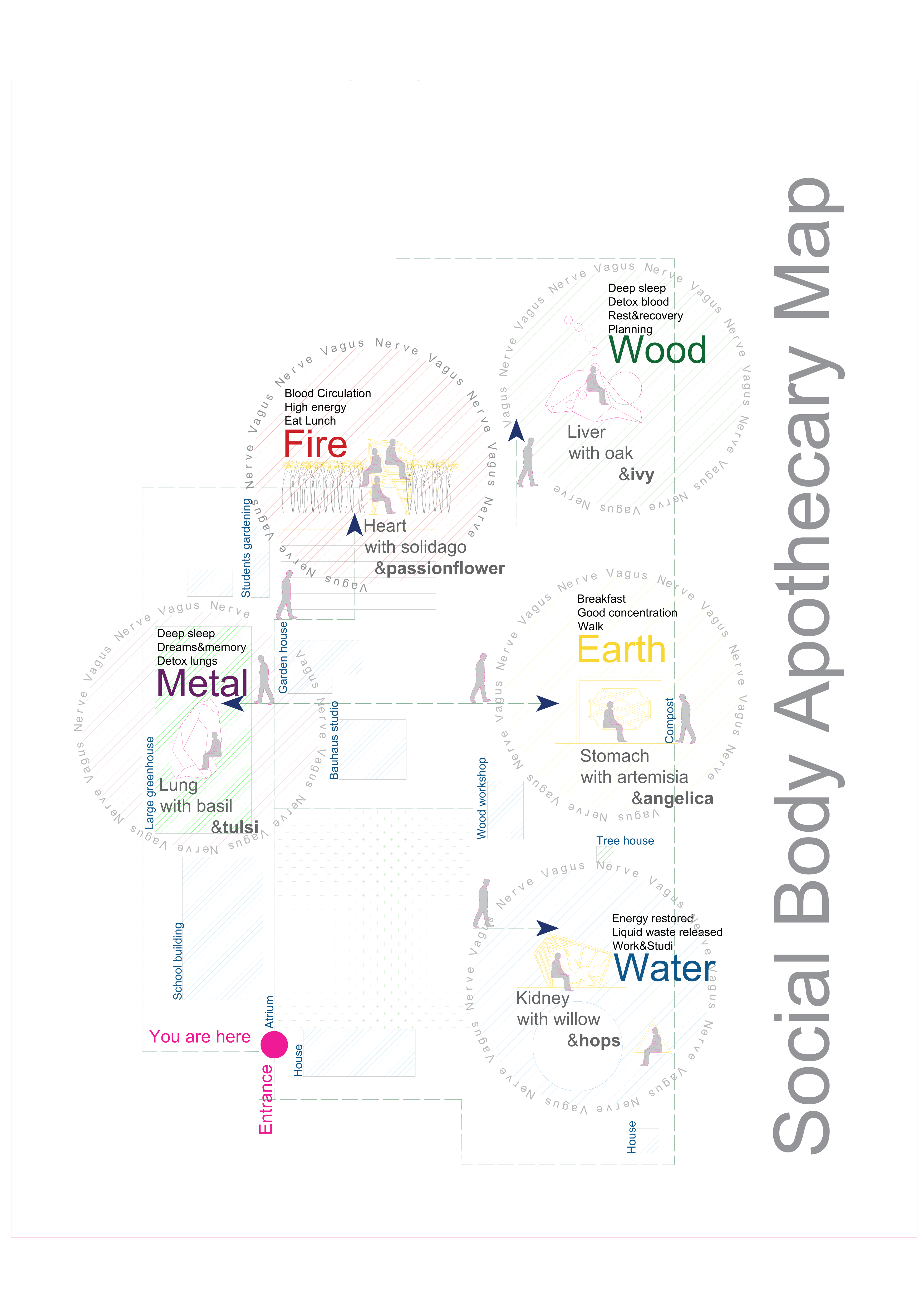
Illustration: Kitti Zsiga
The Social-Body Apothecary works with the body as garden and the garden as body. We combine intercultural plant knowledge with bodywork and create space for questions around systemic violence, resilience and regeneration. Through this process, medicinal encounters take place that address the social body.
The body that we are proposing is not strictly anatomical. It is mixed, hybrid, queer, monstrous, multiple, relocated, a holistic being that defies norms…
What is the social body?

The apothecary that we are proposing values the knowledges and resources stored in our bodies and lands. Making medicine together is a practice of resistance against structural violence. By building community we can understand the connections between symptoms that appear in individual bodies as indications of what might be rooted in systemic injustices. Through coming together, exchanges and conversations arise that reveal how the experiences we often feel alone with are personal and collective, shared and different. In this process, we come to understand that our experiences are never isolated, but rather exist within a wider context and can meet our bodies in the presence of others as well as the plants of the garden through their medicinal insights, engaging in healing as a collective process.
The ‘apothecary’ originally referred to both a storage space for the medicinal resources and a role in the community, the person who held these knowledges and was available as a resource to distribute them. We propose bringing these back together by acknowledging how these intuitive knowledges are held in the body as a living and intelligent repository. As such, we can reconnect our bodily navigational systems with the living world we are embedded in.
How does place guide us?

The first incarnation of this project took root in a former garden school in Berlin that was closed and overgrown, then temporarily revived as a social centre for art, ecology, and cultural practices, dedicated to the local neighbourhood.
The site is coordinated by Berlin Mondiale, a citywide network of cultural practitioners and artists of urban practice in the context of migration, asylum, and exile. At this intersection, the Social-Body Apothecary offers bridges to be built with the living knowledge and stories of migration and integration of the community through embodiment, art and healing practices. This process involved collaborations with women ranging from ages twenties to eighties, many from the neighbourhood coming from migrations backgrounds throughout the SWANA region. ‘SWANA’ stands for South West Asia & North Africa, a less colonial term for the incredibly diverse geographic area with cross-pollination of crossroads ancestries, articulated by the archival hub for the re-membrance and reclamation stewarded by River Rose Remembrance. We worked with groups of children, with visual and theatre artists of mixed abilities, among others. The hope is to provide a space where people can reconnect with their ancestral knowledge of plant life and share horizontal practices for collective health.
To begin with, the garden is mapped through organ centres, with the vagus nerve as a medicine cart that circulates among and throughout these, integrating the entire garden-body and extending into the local neighbourhood.
Why organs?
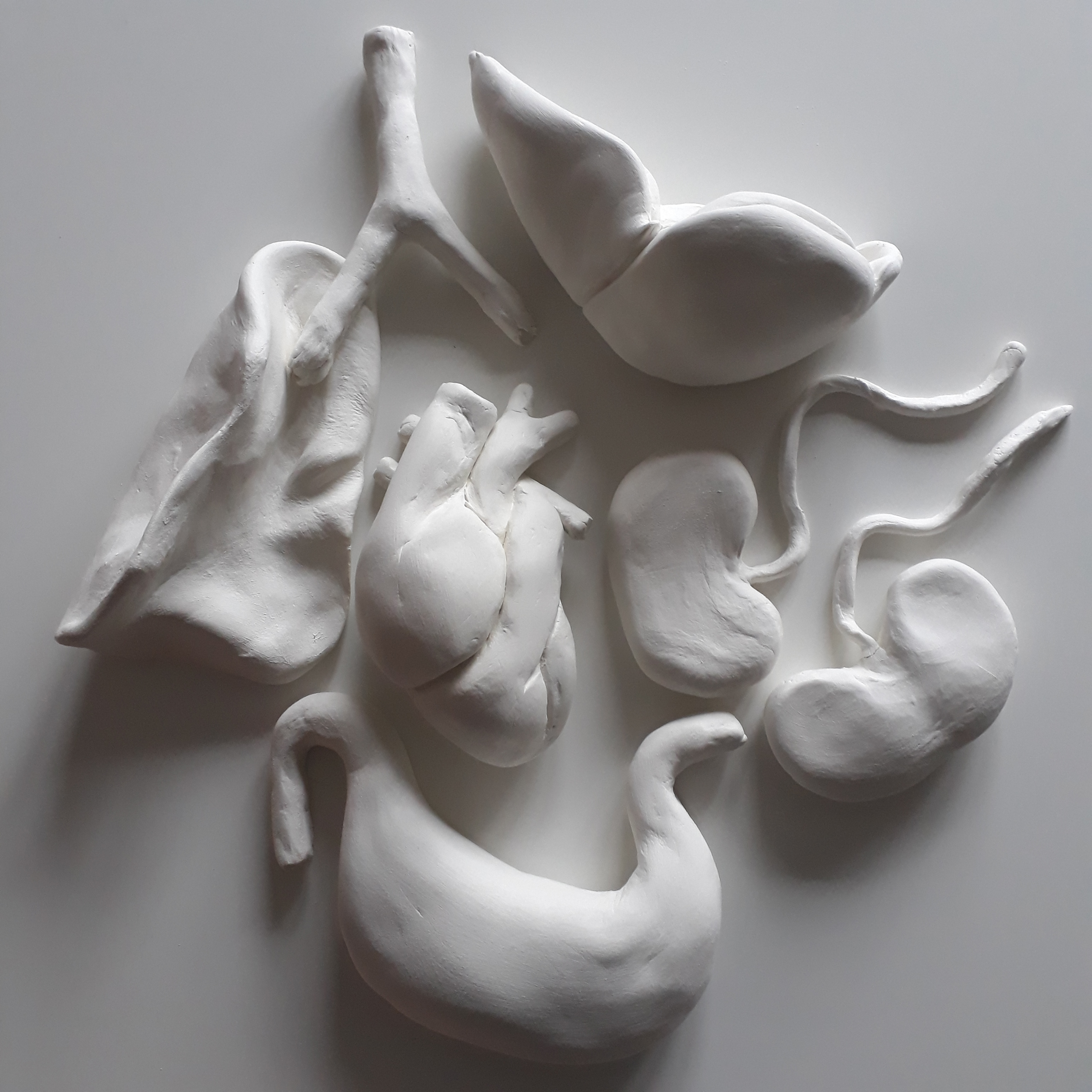
Each of the organs specialises in particular processes, serving their role in the whole, but never acting in isolation. The organs operate in concert with one another, collaborating and conspiring together towards the holistic vitality of the organism. We see this in the individual human body, in the garden, and potentially in movements working within wider social systems.
Organs are delicate yet resilient, they are subtle yet massive, crucial for the operation of the body yet tender. Being with the organs invites porosity, vulnerability, and resilience.
Each of the organ-dwellings is situated in relation to particular areas of the garden that correspond and plants that ally with its actions. The kidney with its filtering, relating, detoxing, and absorbing actions is situated in the water region, by the ponds and willow tree. The heart who works on connecting, pumping, circulating, orientating is situated in the wild field of goldenrod, where all directions towards the edges of the garden are in view and brought together. The stomach whose work of digesting, metabolising, processing, breaking down, and catalysing align with composting processes. The lungs who enable breathing, releasing, circulating, resonating, and grieving are matched with the moist microclimate of the greenhouses, a transparent otherworld that makes life possible in a unique way. And the liver, with its transmuting, transporting, metabolising, and detoxing actions lives in the underworld forest adjacent to the orchard, among an old oak tree and sea of evergreen ivy. The organ-dwellings are spaces to encounter these processes taking place within us, seemingly invisible but vitally palpable.
As you will see, many of the plants appear in multiple organ centres, true to their multiple relationships. The vagus nerve as a flow that roams among all the organs and its allied plants are marked to indicate their partnerships with both this particular organ and the workings of the nervous system.
Why dwellings? Structures – architectural and social

The organ-dwellings, and the practice of dwelling within our organ environments, invite experience from another perspective. Though the organs seem outwardly invisible and untouchable, we can connect with internal experiences supported by architectural re-imaginings; spending time in these spaces, among the allying plants, offers another possible experience of the internal. Simultaneously, they serve a particular function, offering particular modes of being with/in the garden.
How can you see from inside? How does your experience of seeing out shift your senses? How might that inform your readings of bodies in place? How can the act of dwelling be resourceful, an anchor point to work with the flow of the whole, rippling into wider social scales, and all the connectivities within those layers?
The size of the structures invite you to place yourself inside, they invite you into an embodied experience of being within the organ itself. The different seating positions creates different relations by the positionality of your body in the place. Providing a frame, the dwellings offer particular postures to relate with your own body, with the place, and with others.
The design strategy we embraced involved minimal structures that are held together with the minimal crossings needed to create stability. The lines of wood always form a skeleton which leaves space for others – for air, for sun, for plants to take over, for unknown experiences. The structures are meant as a helping hand, to facilitate encounter, enabling embodied knowings to become more available and palpable. The wooden structures offer clarity, with the minimal geometry to hold you. All the while, these constructions are vulnerable themselves. They are impacted by weather, by visitors, by wear and tear, by the unexpected and uncontrollable autonomous life within the place.
Community program
“Spaces of tranquility, care and healing”
23, 24, 30 September 2022 – 01 Oktober 2022
In the frame of: “Urban resilience – body”
Cooperation partners: Berlin Mondiale
Every day 14h – 18h Sauna
Every day 14h-19h Herbal clinic: herbal medicine & treatments
23.09.22 14h – 16h Workshop: Embodying Water. Led by artist: Shannon Cooney
23.09.22 16h – 17h Ethiopian Coffee Ceremony
Every day 16h – 19h Massage Studio Fadime. Led by therapist: Fadime Savun
24.09.22 18h-19h Workshop: Family Tree. Led by artist Mojisola Adebayo.
30.09.22 14h-16h Workshop: Vocal vibrations. Led by artist Xenia Teniko
01.10.22 14h – 17h Workshop: Interwoven. Led by artist Claudia Hill
01.10.22 14h – 19h Workshop: Herbal readings. Led by artists Siegmar Zacharias & Shelley Etkin
 PAZ PONCE _ PORTFOLIO